Fiddling Around in New Holland PA

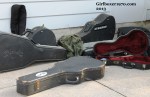
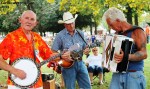
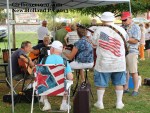
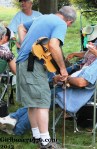
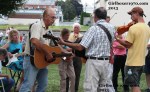
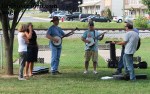
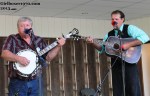
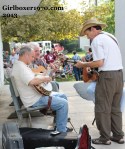
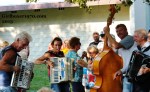
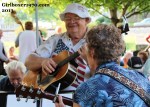
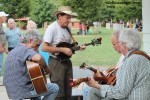
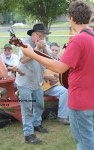
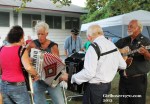
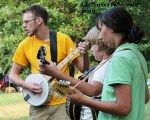
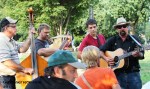
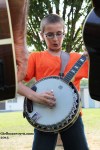
A mass of people converged in New Holland, PA, at the Community Memorial Park for the grandest fiddler’s convention in Pennsylvania.  New Holland has hosted this free music festival since 1988 and it is attended by thousands of musicians and spectators over the Labor Day holiday weekend.

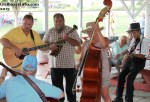
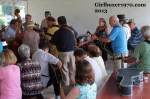
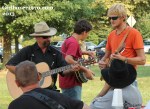
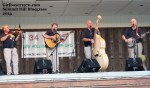
The event is sponsored by the New Holland Summer Arts Association and draws both local and out-of-state participants.  The Fiddler’s Festival features Bluegrass, Country, Gospel and Folk music.  Acts perform onstage using microphones, but the majority of the music comes from performers gathered in the park.  Groups ranged from a duet to large crowds, jamming tunes, dancing and singing.

Performances on stage included Summit Hill Bluegrass, Chester County Boys, Herb and the Boys, Bill Reber and the Boys, New Found Grass, Ramona Trump, Separate Directions, Pine Ridge Ramblers, Master Strings, pianist Phyllis Sands, Dean Sapp, JR Wehner, New Lancaster Bluegrass, Homer & Lynn, The Ramblers and Gospel Messengers.

The weather was beautiful, the sun was shining and music was flowing.

Click on the first thumbnail to open the photo gallery.  Thank you for stopping by my blog!  Enjoy the photos!  ~P.

Retired Unit #20 York Emergency Services Rusts

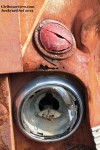
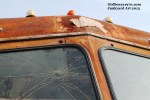
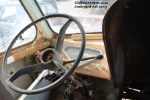
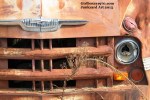
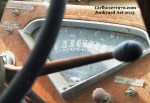
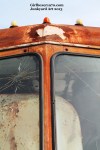
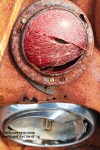
I stopped in my tracks at Baughman’s Salvage Yard as I wandered around taking photos of vehicles in various states of decay.  There was a beautiful, (eye of the beholder) vintage ambulance or emergency vehicle among the lines of rusted vehicles, with York, PA, barely visible.

Imagine the stories that came with a ride in this ambulance.  The last date of inspection was 1999.

Thanks for visiting my blog!  Click like and share with others.  🙂 ~P.

Click on the first thumbnail to open!  Enjoy!

Back in it's hay day.

Back in it’s hay day.

The following information is from a comment below by Jim, who also email the photo above, to me.  Thanks Jim!  ~P.

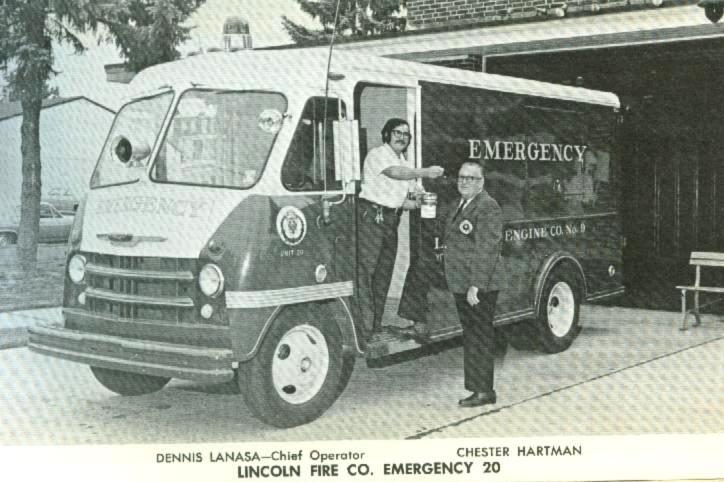
I believe it was a 1956 Chevy but I could be wrong on that. I had to buy parts for it back in the sixties and that year sticks in my mind. Before it was RED, it was white and some referred to it as the “Ice Cream” truck. It responded to all major fires and served hot coffee, soup and donuts to the FFs and those displaced from their houses. It was a “haven of heat” for those that fought fires that occurred in the winter. These were the days when ambulances did not respond routinely to calls and it also served as a medical/first aid/rehab unit.


Its responses were not limited to York City, it also was requested by many county FDs for major fires. It was one of the few (if not the only) city apparatus to have a “County” low band VHF radio installed. As stated before, It was owned and operated by the Lincoln Fire Company.
Two of its busiest years were 1968 and 1969 and anyone older than 10 at that time should remember what was happening in York.

It also stood by at the Kiwanis Lake Labor day celebration each year and provided first aid services to the crowds. These were the days before “EMTs” and a certified Red Cross person with Standard and Advanced first aid was the highest level of training available. Mouth to Mouth resuscitation was becoming popular as well as that ” new thing” called CPR.

Its death was due to several issues: Lack of Volunteers (the volunteers that joined the station wanted to fight fires, not serve coffee), county FDs establishing their own Canteen trucks with a much faster response time, expense of operation, the age of the vehicle, and IMHO-better fire suppression, better trained personnel, and better fire prevention in York City led to a reduction in the number of major fires, in which its services were needed. It took a while to make coffee, buy donuts and respond. Towards the end, it would be responding and the event would be over.

Maybe the Queen of Sparta was a Ho

Pattie Crider

WRT 225.101

Response 2

September 4, 2013


Questions Addressed by Rhetorical Theory Reading

            Two educational issues addressed by the reading assignments were, who was historically considered a rhetor, and what motivated a rhetor to give public speeches. The first question is in regard to the speakers’ expertise and practical knowledge to be considered a rhetor.  The second was determined by the type of speech an orator delivered.

Historically, rhetoric was used by those who had a “high place” in society.  These people, men to be specific, received an education and were looked at as prized persons of the community. It was a position most likely achieved by birth, which fortunately, included a solid education.  The process of learning the art of rhetoric changed when the Sophist Influence made it possible for anyone having the money, to learn how to use rhetorical speech.  This influence did more than just educate people in the art of speaking, it also taught cultural acceptance as society became more and more diverse.  Learning rhetorical skills gave people the ability to use the power of memory in general education and in practical life situations.  People were able to represent and protect themselves by applying their linguistic abilities.

Gorgias’ essay, “Encomium to Helen” is an example of how to influence an audience to reach the same conclusions as the rhetor.  Gorgias used the rhetorical techniques he learned to write a speech in order to uphold the good name of Helen of Sparta, regardless if she had been taken from her husband against her will, or willingly.  His speech supported going to war against the kidnapping prince in Asia Minor, to take back Helen.  Gorgias spoke to clear Helen of any wrong-doing, calling her “blameless” and a “victim of persuasion” who was “tricked by false words.”  The speech was very colorful, lively, and clear that Helen was indeed, a victim.  My thought after reading Gorgias speech: perhaps Paris, Prince of Troy, had a few rhetorical lessons under his belt before he began to “woo” the Queen of Sparta, using his education for a nefarious, personal agenda.

victim or ho?

victim or ho?

Bones~Aliens in a Spaceship

Pattie Crider

WRT 225.101

Introductory Activity: Bones

September 4, 2013


Cast of Bones

Cast of Bones minus Zack who turned out to be an accomplice to a serial killer.

Character Discipline and Theme Analysis of Bones Season: 2, Episode: 9

“Aliens in a Spaceship”


            The genre of program determines the theme and discipline of the characters. Bones is a crime solving program and the focus is on two disciplines, science and law enforcement. Underlying themes of the program are personal and work relationships, religion and death.  This specific episode featured the antagonist as serial killer who kidnaps two of the protagonists, Bones and Hodge. Through the use of logic, science and technology, the kidnapped scientists are rescued by the FBI agent.

The concept of Bones is a group of geniuses that solve murders through the study of bones. The group works closely with the FBI to determine the perpetrator in hopes of capture. The main cast has unique personalities that create many secondary story lines. This is necessary in all writing. Bones, the main character, is logical and relies on science to answer questions.  She has no higher power belief. Agent Booth, while an expert in catching criminals, relies on his experience, gut feelings and faith in God to achieve his goals. The pair continuously has conflict over religion and underlying emotions for each other.

The remaining sub characters are all scientists but have individual focuses in order to be an important part of this genius group. Angela’s specialty is visual art, recreating what happened to the victims.  Hodge, who is deeply in love with Angela, specializes in chemistry.  Camille, the motherly figure who is having a sexual relationship with Agent Booth, fields the psychological aspects of the criminals and Zack, the baby of the group, is a driven, math genius.

This episode of Bones has re-occurring themes that the cast must tackle, ego being a significant one.  Also significant in this episode is “The Grave Digger,” an “invisible” serial killer, is shown as “God-like” having complete control over his victims and their families.  Bones and Hodges must rely on their brilliance and MacGyver-like skills of survival; they escaped certain death at the hand of the Grave Digger.  Graphic scenes, love confessions, serial killers, explosions, kidnapping and attractive people in well-written stories are popular in the 21st century.  The story line and characters of this program transfer well to television, capturing an audience following.

Not relevant to my paper and not in the version I turn in to my professor.  Angela is smoking hot!

~P.

8 Hours of Media

Nutella

Pattie Crider

WRT 320 Digital Writing

Digital Literacy Narrative

September 5, 2013

8 Hours of Media


            What I can clearly see, after documenting specific use of technology is: my life would not be the same without it.  Technology is the vehicle that drives humans. Unless you live in a secluded, undeveloped area of the world, technology has an impact on nearly every moment of the day.

I began using media thirty minutes after waking and used it, nearly continuously, until retiring for the day. In the eight hours I logged, I found it most interesting that my media time frame began with me trying to reach my child and ended with her reaching me, as I left my final class.  I could not live life without personal access to others via my cell phone and the Internet.  I am not alone in this thought. Most of the world could not function as we know it, without the technology humans have created.

I consumed information digitally on my cell phone and laptop through-out the day for classroom information, personal research and interaction with friends and associates. I produced information and shared it worldwide on the Internet and also participated in personal messages by cell phone and computer. While driving to and from campus, I “collected” digital images with the intent of sharing them in the future on the Internet for the enjoyment and education of others. My life is nearly constant in the media in the aspect that I freely share my life with others on my blog site, Twitter, Facebook and other social media outlets. My life and approximate whereabouts is available 24 hours a day, 356 days, a year at the touch of any Internet capable device.

Media has become the “auto drive” of my life. I react and use it, without giving thought to losing this technology. I am driven to interact with people all over the world. This sounds rather grand of me, but I am just a speck on the earth that has managed to gain the attention of many other specks populating the earth.  Without having media technology, much of the world would not know of my existence, possibly influencing my career path. My perspective differs from most others. I intentionally “put myself out there” for all to examine and draw their own conclusions. As a writer, this style humanizes me, making others able to relate to me personally and professionally. That “reader to writer” relationship maintains them as dedicated consumers of my daily, never-ending online diary.


Reference: media use log

8 AM Phone call to Tesla- redirected to voice mail.

8:10 Received call from Dale

8:15 Pocket dialed my dentist

8:16 Phone call to Tesla- redirected to voice mail.

8:17 Online: Checked YCP email, Yahoo email, Facebook, Girlboxer1970, Twitter and played Candy (Crack) Crush.

9:30 Texting a friend from high school on my phone

9:35 Took pictures with my digital camera on the way to campus to later post on the “You know you’re from York when,” Facebook Page.

10 AM Watched an episode of the television show Bones through Netflicks in Professor Waddel’s Interdisciplinary Writing course.  Used my cell phone to create enough light to take notes.

10:57 Checked Facebook and text messages.

11:07 Received a text message from another friend from high school.  She would be stopping by my house to drop off clothes for my daughter.  Woot!!

11:30 Internet use in Professsor Carsey’s Rhetorical Theory class.  Viewed a German Sheppard for adoption and applied Pathos to make an argument for why “we should adopt a shelter dog.”

12:05 PM Took digital photos of the campus in order to create a Spartan article and blog post about the changes on campus.

12:30 Online: Checked YCP email, Yahoo email, Facebook, Girlboxer1970, Twitter and played Candy (Crack) Crush.

1:15 Responded to text about clothes being dropped off at my home.

2:30 Checked YCP website to see what room my Geography class was held.

4:02 Received a return phone call from my daughter.

ENDNOTE: At least I’m not hooked on Farmville anymore!

~P.

Amish Mafia: Esther Schmucker Opened Multiple Abuse Cases Against Boyfriend This Summer

So I’m guessing this isn’t the man the Old Amish Sect lady was talking about when she told Esther she needed to find a good man.  Personally, I think it’s all promotional but hey, whatever.  Filing a PFA and then not showing up for court is a no-no.  It makes it harder for women who are really being abused to get a PFA because of drama like this.

Can any of this make it onto the program please? ~P.

Amish Mafia: Esther Schmucker Opened Multiple Abuse Cases Against Boyfriend This Summer.


What I Have Learned About Rhetoric That I Didn’t Know Before

Pattie Crider

WRT 305

Response 1

August 30, 2013

rhetorical thinking

rhetorical thinking

What I Have Learned About Rhetoric That I Didn’t Know Before

I started this class having never given much thought to rhetoric- the definition or the origin of the word. It sounded Greek. I knew that it had to do with language and the manipulation of language, beyond that I was pitifully ignorant. What I learned is, there are endless definitions and examples of what and how rhetoric is used in language, with the intent to persuade a consumer. This did not surprise me, as all written word is bias, and has influence in some fashion to the consumer. The two most interesting things I learned in the reading were how important rhetoric became in spreading the word of Christianity and second, how long it took for women to be accepted as rhetorical thinkers.

Rhetoric has negativity permanently attached to it because of its ability to persuade people. The persuasive orators in history would use fact, logic and emotional appeal to capture and affectively change the thinking, or at minimum, cause a new type of thought, within their audience. The spread of Christianity was done primarily through oral speeches to massive crowds. The speaker, whether a priest, a disciple or Jesus himself, would lecture, and the crowd listen, open to learning about this new religion call Christianity. Not only did Christianity use rhetoric to inform and persuade, it influenced the composition of religious writing. In time, a “handbook” for Christians was created that was stylistic in format and text, using punctuation to make the written word clear to be read, rather than heard. This may very well be the most effective use of rhetoric in history as Christianity has managed to spread worldwide since medieval times.

I knew that it took until the Renaissance period for women’s writing to at least be acknowledged, but it surprised me to read that “almost all women were forbidden to speak in public.” I don’t know exactly what is written by the Apostle Paul that upset Margaret Fell in the late Seventeenth century, but I applaud her for aggressively defending the rights of women to have a voice among the dominating men. It was a start that took two more centuries to finally cause a change. Honestly, that blows my mind. Even in the Twenty-first century, males continue to be the dominant of sexes in positions that use rhetoric. Be it lawyers, priests or writers, women have not reached the same level of acceptance that men have been given since the first orator prepared, memorized and addressed the public with his speech.

One Tattooed Fox

First photo session with the tattooed model, Elyse Fox, from Dover, PA.  This was a relaxed session, shooting Fox posing in her own home.

Future photo sessions to come!  Click on the first thumbnail to open the photo gallery.  ~P.

Abandoned: Eastern Pennsylvania State Institution for the Feeble-Minded and Epileptic

Administration Building Early 1900's

Administration Building
Early 1900’s

“Pennhurst State School and Hospital, originally known as the Eastern Pennsylvania State Institution for the Feeble-Minded and Epileptic is positioned on the border between Chester County and Montgomery County in Pennsylvania. Pennhurst was an institution for the mentally and physically disabled individuals of Southeastern Pennsylvania.

“In 1903, the Pennsylvania Legislature authorized the creation of the Eastern State Institution for the Feeble-Minded and Epileptic and a commission was organized to take into consideration the number and status of the feeble-minded and epileptic persons in the state and determine a placement for construction to care for these residents.”

Overhead view of campus

Overhead view of campus

The Superintendent reported to the Board of Trustees that:

“It is without question absolutely wrong to place the feeble-minded and epileptic in the same institution. They are not the same; they are as different, one from the other, as day is from night. They are mentally, physically and morally incompatible, and require entirely different treatment.”

“On November 23, 1908, “Patient number 1” was admitted to the hospital. Within four years of operation, Pennhurst was already overcrowded and under pressure to admit immigrants, orphans and criminals.  Residents were classified into mental categories of imbecile or insane, into physical categories of epileptic or healthy, and into dental categories of good, poor or treated teeth when admitted.

Henry H. Goddard

Henry H. Goddard

Goddard believed that feeble-minded people should be removed from society and placed in institutions such as Pennhurst.  He also published a book based on the heritage of a patient at Pennhurst, convincing readers, parents and doctors that the best place for mentally challenged children was an institution, otherwise the gene pool would continue to break down and all children born would also be feeble-minded and a future criminals.

In the Biennial Report to the Legislature submitted by the Board of Trustees, Pennhurst’s Chief Physician quoted Henry H. Goddard, a leading eugenicist, as follows:

“Every feeble-minded person is a potential criminal. The general public, although more convinced today than ever before that it is a good thing to segregate the idiot or the distinct imbecile, they have not as yet been convinced as to the proper treatment of the defective delinquent, which is the brighter and more dangerous individual.”

In 1968, conditions at Pennhurst were exposed in a five-part television news report anchored by local CBS10 correspondent Bill Baldini, titled Suffer the Little Children. This video is 36 minutes long and 100% heart breaking. 

Bill Baldini reports on the condition of Pennhurst

Bill Baldini reports on the condition of Pennhurst

In 1983, nine employees were indicted on charges ranging from slapping and beating patients (including some in wheelchairs) to arranging for patients to assault each other.

“The Halderman Case, which resulted in the closure of the institution, also detailed widespread patient abuse.  A class-action case was filed against Pennhurst State School on behalf of its patients. The case was heard by U.S. District Judge Raymond J. Broderick, who in 1977 ruled that the conditions at the institution violated patients’ constitutional rights. Pennhurst State School was ultimately closed in 1987. Its 460 patients were discharged or transferred to other facilities in a process known as deinstitutionalization that lasted several years, and included discussion of treatment plans with each patient’s family.”

After a decade of controversy, it closed on December 9, 1987.

Pottstown 1972

Pottstown 1972

As of 2010, the administration building has been partially renovated and reopened as the Pennhurst Asylum haunted house. The attraction has been successful, though controversial among locals and those previously affiliated with Pennhurst.

Penn Organic Recycling LLC currently operates on four-and-a-half-acres of Pennhurst, offering topping, composting and food waste services. The Department of Environmental Protection permitted the composting operation at Pennhurst to maintain no more than 25 tons.

Pennhurst has been featured on the shows Ghost Adventures on Travel ChannelGhost Hunters on SyFyCelebrity Ghost Stories on BIO, The Haunting Of… ‘Beverley Mitchell‘ on BIO, and the self-titled movie ‘Pennhurst’, featuring Beverley Mitchelland Haylie Duff.  (Wiki)

Presently, there are businesses that operate during the day and security paroles the grounds 24 hours a day.  Many of the building are not safe to enter for any reason.  I was told people do continue to trespass at night to “party” but will be arrested if caught.  Just past the Veteran’s Hospital on the right the road began to narrow and eventually became gravel.  There was building after building, decaying in the bright sunshine.

Veteran's Hospital

Veteran’s Hospital

Pennhurst 047

Huge water tower and flag next to the Veteran’s Hospital

The first human I found was working in a leased garage.  I told him I saw all the abandoned buildings and was intrigued to what this area was.  I was nearly certain I was at Pennhurst State School, or damn close to it, but I didn’t want to tip him off.  He said, this was formally Pennhurst, a mental institute. and the big buildings were down the dirt road.  I asked if he thought they would mind if I went down and he said, “I don’t know, just go down and see.”  Sounded good to me!

The mulching company had huge piles of fresh mulch that actually improved the scenery…making it look as though it is building itself a barrier from the outside world.  The mulch worker said he knew a little bit about Pennhurst and told me how eventually the government shut them down.  “We just lease the land for mulching.  The really impressive buildings are down around the corner.”  I was further intrigued and asked him if anyone was back there.  “Oh yeah, they’re getting ready for the Haunted Asylum.  Just keep going left.  I can’t let you get any closer to where we are working.  Actually, I’m surprised no one has stopped you so far.  You know they charge people with trespassing.”

I told him I’ve never been in trouble in my life and didn’t want to start now.  He laughed and said he wasn’t going to call the police and it had been nice talking to me.  “Just keep to the left and you’ll see them working.”  I thanked him and Ying and I went back to my car.

Pennhurst 229 Pennhurst 221

Yes, this sign referring to the mulching process, but really, the entire property is a compost.

Yes, this sign is referring to the mulching process, but really, the entire property is a compost.

There were buildings everywhere.  Some were small barns, greenhouses, towering mansions and huge industrial buildings.  I photographed everything I could see and checked out the inside of every building that looked safe enough to approach.  As I was walking around, a truck passed me and I waved.  They nodded and kept going, I guessed they worked for one of the companies on the property because they had no interest in a woman walking a dog with two cameras around her neck.

I finally came to the Pennhurst Haunted Asylum and found a working crew, just as the mulch guy said.  There was probably at least ten people working to be ready for the 2013 scaring season.  I began speaking to just one person but after awhile there was a large group chiming in on the history of Pennhurst and the Haunted Asylum.  I absolutely could not go inside their “staged” mansion and take pictures and I was fine with that.  I was offered a guided tour on a golf cart and that sounded better than a Carnival Cruise at the moment.

I stayed with the “Asylum Group” taking every moment to get photos.  I learned three people own the Pennhurst property but very little, other than the two building being used for the Haunted Asylum, are being renovated.  My guide said some are just to far gone to rehabilitate.  The history of this place is so ugly, it would be good to see more buildings used for something positive.  There is controversy about the Haunted Asylum.  Some people believe it is wrong to use any building on this property as an amusement attraction.  My opinion, this place has such a horrific past for children and young adults, any positive experience here would not be blasphemous, but healing.  The attraction is fictional.   There was never a “torture chamber” or “prison” in the administrative building.  But, I’m sure there are other buildings that held rooms just for that purpose.  I can’t get past the clip in the YouTube video where the doctor admitted  to giving a patient a painful injection of no medical use, solely to torture him for injuring another patient.  That is just WRONG.  No doctor should ever be injecting a patient just to cause them pain.

A collection of historical Pennhurst images, mostly courtesy of J. Gregory Pirmann, former special assistant to the superintendent at Pennhurst.  These video pictures are from far better days at Pennhurst State Hospital.

The first building was used by the union workers as a small office and work area.  The middle and back half of the roof of this building has collapsed.  Union paperwork and even a checkbook was laying in the office area.  A crushed wheelchair was at the front door, that someone pried open, only to find there was no way to get past the roof.

To best enjoy, click on the first thumbnail of each gallery to open the photos to full-size.

Very few of the greenhouses still have glass in the windows.  Plant life had no problem taking over, and now trees grow through the tops.  I disturbed a cat but he was so fast, all I caught was his butt.  Outside the greenhouses were random piles of trash, chairs and furniture, havens for bugs and snakes.

The foundation and cement around this house was so bad I didn’t want to walk up to it.  The sidewalk was being swallowed up by the ground.

Pennhurst 131

Pennhurst 126 Pennhurst 127

Pennhurst 128

Behind these houses was a small, dingy house.  The smell of the house was bad but the backyard was even worse.  Ying and I investigated (I was betting something nearby was dead) and I found an old wagon filled with scummy water.

A large stone house looked like it wasn’t built in the early 1900’s.  It had a modern look with porch and wooden columns rather than stone.  The house was impressive and had a green hue due to the mold, moss and foliage.  If the foundation of this house is solid, it would be a great rehab project.

View from a distance.

Pennhurst 111 Pennhurst 155

Hello deer

Hello deer

This interested Ying more than the buildings.

This interested Ying more than the buildings.

Darling Fire Hydrant

Darling Fire Hydrant

The lights on the property look out of place.

The lights on the property look out of place.

Large brick building with bolted metal doors.

Large brick building with bolted metal doors.

The windows were busted out so I did my best to catch what was inside. There was very little sunlight making it inside to brighten the room for photos.

A fire takes out a portion of roof.

A fire takes out a portion of roof.

Pennhurst 207

Pump House maybe...

Pump House maybe…

Pennhurst 234

Pennhurst 241

Administration Building 2013

Mayflower Hall-said to be haunted!!

Mayflower Hall-said to be haunted!!

Pennhurst 244

Rear Administration Building (Pennhurst Asylum)

Rear Administration Building (Pennhurst Asylum)

Steeple on Administration Building

Steeple on Administration Building

Pennhurst 249

Industry Hall

Pennhurst 242 Pennhurst 246 Pennhurst 247 Pennhurst 248 Pennhurst 250 Pennhurst 251 Pennhurst 252 Pennhurst 256 Pennhurst 257 Pennhurst 258 Pennhurst 259Pennhurst 264 Pennhurst 266

brick rubble

brick rubble

Pennhurst 268 Pennhurst Admin Building

Philadelphia Hall

Philadelphia Hall

The last building I stopped at was a former house.  The trees in front of the porch grew through the spouting, forcing it to separate from the porch.

My road trip was a complete success and while I would love to be inside some of the building farther out on campus, I can’t imagine trying to “sneek” into them.  Now that I know the people that work here and the names of the owners of the Pennhurst property, maybe I can get permission to take photos at the pool, the hospital and the campus housing.  I had a great day, stepping back into a place in history that most people have never heard of.  Pennhurst may be closed but it will never be forgotten.  God Bless all the children who lived there in unfit conditions, and to the staff that tried their best to care for patients with what little the Commonwealth of Pennsylvania gave them.

In the past, and now through the Halloween season, Pennhurst continues to cause nightmares and screams.

~P.

Pennhurst Asylum employees were SUPER nice!

Pennhurst Asylum employees were SUPER nice!

Dover United Church of Christ

Dover United Church of Christ 2013

Dover United Church of Christ 2013

45 W. Canal Street

Dover,PA 17315

717-292-3743


“Out of the interest of nineteen men, in providing a site for Sunday school sessions of the Dover Union Reformed Sunday School the present church building, excluding basement and the annex, was built. The building was erected by C. H. Quickel for a contract price of $4,710. This did not include excavation, foundation wall, bell and windows.

Ground was broken on May 20, 1902, with a team of 4 horses scooping the ground out and the cornerstone was laid in the fall of 1902. On August 23, 1903, the first Sunday School Session was held. On the following Sunday, the Reverend O. P. Schellhamer conducted the first Worship Service and preached the first sermon. Dedication Sunday was September 6, marked by three services. Total approximate cost of the entire project, including windows, lights, pews, chairs, furnace, was slightly more than $7,000.00.

The United Church of Christ in Dover, with its membership of 250, began modestly in 1902 when the people chose to separate from the parent church, Salem, and began to conduct worship and Sunday school in a school located across from the present church site. This was the third church established in Dover know as the Dover Union Reformed Church.

Reverend Oliver Shellhamer supplied pastoral needs from the time the first sanctuary was completed in 1903 until a year after the organization of the congregation as the Reformed Church in May 1920. It is part of the Salem-Dover Charge. Charger members were: Lucy Bentzel, Margie Lauer Nagle, Anna Bentzel Paules, Mrs. Emory Seifert, Edith Toomey, Kate Wehler, John A. Deardorff, Jr., C. W. Guise, and Charles P. Toomey.

Dr. J. M. Gross donated a part of the tract of land on West Canal that he purchased from Dr. John Ahl on April 1, 1876. It had a frontage of 207 feet and a depth of 250 feet. Dr. Ahl purchased the tract from the estate of Harriet Fries on April 2, 1866. Originally, this was part of the Jacob Joner farm which was conveyed to John Sharp who seems to have transferred it to his son George Sharp who administrators conveyed a little more than 16 acres to John Strayer who died about 1832.

Before Dover Borough was supplied with its own Lutheran and Reformed Churches, it was customary for the villagers to attend services at Strayer’s Union Church. In order to make it easier for pedestrians to get to Strayer’s Church, a narrow strip of land skirting along the northern side of the Canal Road was acquired by the church officials from the landowners, Joseph Hantz and Edward Keesey.

The fence posts were set back from the Canal Road about five feet and the strip of land between the road and the fence was leveled off; making a serviceable side walk which was good for wet or dry seasons. Henry Quickel of Dover built the boardwalk over the meadow between the stone bridge, past the old election house to the high and dry part of the sidewalk.

The church is a brick edifice of Gothic Architecture, with a roof of Peach Bottom slate. It is provided with stained glass windows, depicting Biblical scenes and characters. The interior woodwork is of cypress and the pews of polished hard wood.

On August 12, 1903, the first Sunday school session was held in the new church. The lesson was reviewed by Honorable E. D. Zeigler of York.

It was noted in the minutes of 1909 it was necessary to change the heating system at a cost of $355.00. The Acetylene gas generator lights had to be changed to electric in 1911 for a cost of $155.00.

In the fall of 1921, a plot of ground 85 feet in frontage and 250 feet in depth, adjoining the church was purchased from Dr. J. M. Gross. The price was $595.00 with a discount of $100 as a donation to the church by Dr. Gross.

On August 29, 1921 a property at 93 South Main Street, Dover, PA was purchased for use as a parsonage by the Dover Charge (Dover, Salem, and Shiloh).

The first changes in the building began on September 30, 1934, when the Crusaders and Sunshine Bible Classes were given permission to dig out the basement to provide space for class and social purposes. This project grew and continued until completed in 1949, when a service of dedication for it was held on September 25, 1949.

In 1952, the Dover Reformed Church became the Dover Evangelical and Reformed Church.

Major building renovations in 1954 included a reorienting of church furnishings and addition of the apse where the altar is not located. Originally the pulpit and choir loft were in the recess facing our parking lot. Long pews spanned the middle of the nave, providing two side aisles beyond which were shorter pews. With the addition of the present chancel, the pews were rearranged facing it, and the long pews were divided into two sections with the addition of new end supports.

The Annex as added in 1959 and 1960, providing needed classrooms and a social hall. Dedication was on June 20, 1960. More recently, our stained glass windows were cleaned, completely releaded, and covered with protective storm glass in 1973. In the first week of 1977, new carpeting and new pews were installed, which were dedicated January 9, 1977.

In 1994, after breaking ground on May 16, 1993, a new addition began to take shape. In January, they moved into the new facility and it was dedicated on April 24, 1994. This included an elevator style lift, five new Sunday school classrooms and offices for the Pastor and the Church Secretary, a large conference style meeting room, kitchenette, sanctuary level handicapped accessible restrooms, and new entrances to the North side of the building and into the Sanctuary.”  www.gdhspa.org

REVERAND ARIS FOKAS

REVEREND ARIS FOKAS

     “THE UNITED CHURCH OF CHRIST (UCC) IS A MAINLINE PROTESTANT CHRISTIAN DENOMINATION PRIMARILY IN THE REFORMED TRADITION, IN “HISTORICAL CONTINUATION OF THE CONGREGATIONAL CHURCHES FOUNDED UNDER THE INFLUENCE OF NEW ENGLAND PURITANISM.”

THE EVANGELICAL AND REFORMED CHURCH AND THE CONGREGATIONAL CHRISTIAN CHURCHES UNITED IN 1957 TO FORM THE UCC. THESE TWO DENOMINATIONS, WHICH WERE THEMSELVES THE RESULT OF EARLIER UNIONS, HAD THEIR ROOTS IN CONGREGATIONAL, EVANGELICAL, AND REFORMED DENOMINATIONS. THE UCC’S 5,287 CONGREGATIONS CLAIM 1,080,198 MEMBERS, PRIMARILY IN THE UNITED STATES.”  (http://www.doverducc.org)

IMG_0151


Click on the first thumbnail to open the photo gallery.  Thank you for stopping by!  ~P.