Quintilian wouldn’t flip me off

Pattie Crider

WRT 305

Response 9

September 30, 2013

"The Good Man"

“The Good Man”


Quintilian criteria of a “good man” boiled down

            A “good man” in Quintilian thought, is a person who only speaks for matters of “justice, fairness and truth.” This person must be of high moral character and in no way have characteristics of a “bad man” removing the possibility that rhetoric could be called a deceptive art.

Quintilian teaching was often begun in the home of a child, the role of teacher falling to the mother. Historically, mothers are expected to be an excellent role model, and to begin a child’s formal teaching at home. Following a home-schooled beginning, a child began grammar school education under the close tutelage of exemplary professors. Rhetoric was an important part of education and children that showed promise were privately educated in “sermo” to ensure they were broadly knowledgeable on all topics and highly knowledgeable about their specific subject.

A person that is taught to fulfill the role of a “good man” from birth through adulthood in Quintilian theory would then be considered ethical. This is a great theory and perhaps a good way to measure the “good man” in this time period. This seems too romantic of a concept in modern time, proven over and over by the bad actions of our politicians.  If lawyers and politicians were held to this standard today, there would be no rhetors, because there are few of either that are found to have high morals, ethics or standards.
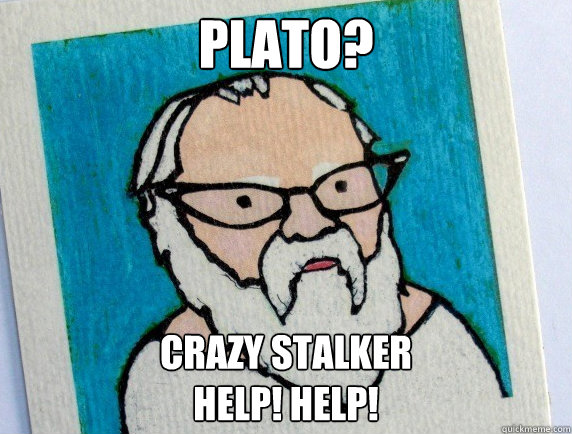
Plato~It is all in the truth of those crazy peoples

Pattie Crider

WRT 305

Response 4

September 11, 2013


He loved the cray cray peeps.

He loved the cray cray peeps.

True Rhetoric and the Characteristics According to Plato

            Plato believed that true rhetoric was more than verbally exchanging thoughts and ideas to hash out a particular human discourse. It was not an art to use for self-promotion or to seek praise of others. Plato believed true rhetoric advanced students in knowledge, not just flattered them with false praise.

The main characteristic of rhetoric based on Plato’s writings would be truth.  Plato believed humans could achieve absolute knowledge and that rhetoric could assist in this achievement. Those who shared good rhetoric were believed to be touched by a higher power, whether a god, goddess or God. This “madness” was divine inspiration and only achievable by those moved by a higher power.  All of this truthfulness was based on the love the speaker had for the higher power, a platonic relationship, one that can never sour.

Plato’s interest was not in producing politicians through his teaching, but elevating those worthy of having love for true rhetoric, that inspired by God.  This fascinates me because I often wonder if an orator would come forward (or anyone, for that matter) and declare to have knowledge directly from the God, would anyone believe such to be true? Most likely the person would be declared insane and scorned for his love of God and attempt to share what he has learned as truth.

Phaedrus and Socrates’ dialogue within the text allows me to believe that people did in fact, speak publicly, guided by God.  People were speaking, whether divinely inspired or driven by money, and others were listening. I wonder what has changed that makes those in love with God and speaking only to promote the truth, be viewed differently now than through-out history. Has society hardened to the point that no one dares believe a man (or woman) could be possessed by a higher power and inspired to share the truth with those who will never reach such success? My personal answer is yes. Plato would say those who know true rhetoric–good rhetoric–will recognize the soul is immortal and in doing so, achieve absolute knowledge.

My absolute knowledge, is more than questionable. 😉 ~P.

Maybe the Queen of Sparta was a Ho

Pattie Crider

WRT 225.101

Response 2

September 4, 2013


Questions Addressed by Rhetorical Theory Reading

            Two educational issues addressed by the reading assignments were, who was historically considered a rhetor, and what motivated a rhetor to give public speeches. The first question is in regard to the speakers’ expertise and practical knowledge to be considered a rhetor.  The second was determined by the type of speech an orator delivered.

Historically, rhetoric was used by those who had a “high place” in society.  These people, men to be specific, received an education and were looked at as prized persons of the community. It was a position most likely achieved by birth, which fortunately, included a solid education.  The process of learning the art of rhetoric changed when the Sophist Influence made it possible for anyone having the money, to learn how to use rhetorical speech.  This influence did more than just educate people in the art of speaking, it also taught cultural acceptance as society became more and more diverse.  Learning rhetorical skills gave people the ability to use the power of memory in general education and in practical life situations.  People were able to represent and protect themselves by applying their linguistic abilities.

Gorgias’ essay, “Encomium to Helen” is an example of how to influence an audience to reach the same conclusions as the rhetor.  Gorgias used the rhetorical techniques he learned to write a speech in order to uphold the good name of Helen of Sparta, regardless if she had been taken from her husband against her will, or willingly.  His speech supported going to war against the kidnapping prince in Asia Minor, to take back Helen.  Gorgias spoke to clear Helen of any wrong-doing, calling her “blameless” and a “victim of persuasion” who was “tricked by false words.”  The speech was very colorful, lively, and clear that Helen was indeed, a victim.  My thought after reading Gorgias speech: perhaps Paris, Prince of Troy, had a few rhetorical lessons under his belt before he began to “woo” the Queen of Sparta, using his education for a nefarious, personal agenda.

victim or ho?

victim or ho?