Gender roles in New Religions

One key issue in the study of NRM was gender role.  Historically, most religions were established by male founders with female followers that participated in worship services.  These gender roles have been long upheld, but the emerging NRMs have succeeded in
breaking this tradition.  (Pike p. 215)

The traditional perspective of gender role in religion has been male domination over females.  This view is found excessively in established religions as well as newly emerging faiths.  “Women have accounted for the majority of participants in American religious
groups…NRM are not consistent in their perceptions or treatment of women, but
in this they are no different from mainstream religions.”  (D&A p. 5)

There are two approaches to the study of gender in NRMs.  The first was a “negative evaluation of NRMs as abusive to women” and the second approach “suggests that relations in new religions are complex and rarely reducible to the simplistic image of male gurus and passive female followers. “  (Pike p.212)  Examples of each approach can be found in the course materials.

In a religion based on a “master-disciple relationship” the male often takes the fatherly role, especially over the female disciples.  Abuse is frequent when women followers must obey without question.  Many high profile religions emerged in the 1960’s and 1970’s following the traditional pattern of a divine male figure.  These charismatic males were
able to create their own religions that became labeled as cults.  (Pike p.216)

Controlling charismatic male leaders have caused a negative view on emerging religions.  In 1950, James Jones, an unadorned pastor became the charismatic leader of Sommerset Southside Church.  His service there was short as his zealousness was too much for the congregation.  After several false starts, Jones founded the People’s Temple in 1956.  His charismatic appeal won him favor in the eyes of many established churches and he eventually became an ordained minister.  Jones visions of the future and preaching style enabled him to convince his congregation to move to Guyana after a magazine released horrifying reports of abuse and financial misdealing.  Jones was able to brainwash
his congregation into a mass suicide in 1978.  Information gathered after the suicide shed light on the cult Jones had actually created.  (Smith p.108-109)

David Koresh was another example of a male charismatic leader that was assertive in having control over his female followers.  The Branch Davidians were an established group and Vernon Howell, later known as David Koresh, became the leader.  Koresh believed under his guidance as a loving father figure, the congregation he referred to as his
family would establish heaven on Earth.  Under this charismatic mans leadership, the women, their daughters and even the men were forced to submit to Koresh as sexual objects.    In 1993 Koresh’s congregation perished during a siege by the FBI and the Bureau of Alcohol, Tobacco and Firearms.  (Pike p.216, D&A p.262-263)

While men were typically the founders of alternative religions, there are groups that emerged under the leadership of women.  Studies found when
females establish a group and function as leaders, the women disciples are seen
as spiritually superior.  Neo-pagans base their religion on a “woman-centered theology” established by female spiritualist, Starhawk.  Also elevating female leadership is the New Age movement.  Both Neo-pagan and New Agers attempted to balance gender equality and avoid “absolute devotion to charismatic leaders.”  (Pike p. 216-217)  Sexual freedom
is important to these groups and sexuality is viewed as an expression of one’s self, separate from their religious identity.  (Pike p. 221)

Christian Science, Spiritualism and the Shakers were established by female mediums and all three groups have male and female leadership roles.  The lack of a single, male charismatic leader appears to enable these groups to avoid the abuse that often develops in male established religions.  (Pike p. 215)  Other religions based on extraterrestrial and
androgynous races, attempt to view their divine as genderless, removing the
importance of a deity having a gender.

The key issue of gender within NRMs is sensitive.  The abuse of
women by charismatic male leaders is a fact in NRMs.  On the other hand, there are established NRMs and ones that are still emerging that give equality to and even celebrate the females within their group.  In either case, gender will always remain a key issue in religious movements.
Defining Cults and NRMs

What is a CULT versus a New Religious Movement?

New Religious Movements can be defined as religions that society considers non-conventional.  Through-out history, religious groups were developed by means of tradition and followed a religious rational.  The NRMs are formed by people wanting to leave traditional faiths behind in order to develop or follow a new religion.  New movements are developedbecause of people’s desire to view themselves or society in a new way.
(Beckford p. 26-27, Weber p. 46)

A religion’s legitimacy may be based on legal, traditional or charismatic
grounds.  Well known religious groups such as the Mormons, Jehovah’s Witnesses and Christian Scientists at their beginnings, were labeled “emergent or alternative religions” and were grouped with “sects, cults, and psychogroups.”(Beck p. 26, Weber p. 46, Daschke & Ashcraft p. 1-2)

Legal recognition has been achieved by past religious movements by collecting and
paying taxes and requiring military service. Because the public fears what they cannot see, NRMs are encouraged to send their children to public schools and have an open door policy concerning their religious services.  Also lessening the wariness of concern is NRMs that do not proclaim the ability to miraculously cure sickness and disease. (Beckford p. 28)  By following these guidelines NRMs are shown a greater tolerance than
those religious movements that seek shelter from the public eye.

Emerging religions distinctly differ from traditional grounds of legitimacy.  Through traditional grounds, obedience is to the person who occupies a position bound by tradition.  (Weber p. 46)  The authority is placed in the position and not the person.  (Dawson Crises p. 81) Examples of traditional grounds of authority would be the Pope, cardinals and the Dahlia Lama.  NRMs seek to create a new “religious world”
by manufacturing a revised version of history, offering new ideals, habitation,
objects of authority and communication. (D&A p. 10-13)  They are formed on adaptations of traditional religions to satisfy people’s wish to view society and the world by
untraditional means.  (Dawson Comprehending p.60)

A common characteristic NRMs share is a charismatic leader.  People are drawn to a person who has charisma and the leader uses this natural ability to attract and gain followers.  Because “charisma can only be awakened and tested, and cannot be learned or taught” the leader is believed to be chosen by a higher power for their position.
(Weber p. 58)  Leaders of this type tend to be volatile and in essence, cause their institutions to be unstable.  It is necessary for the leader to carefully balance their actions to establish and reinforce their authority.  (Dawson Crises p. 85)

Daschke and Ashcraft compared NRM to earthquakes in their book.  It is an excellent way to view religion as a whole because all religions were formed in this fashion.  There was a sudden shaking by an idea or belief and that caused a reaction and this was the ground-breaking period of a religious moment.  Five typologies were introduced to define the qualities of religious groups.

A “new understanding” is formed, opening or awakening people to new thought.  People
tend to live life focusing on the negative aspects they have encountered.  A promise of a better life through religion can be an attractive offer.  A future of harmony in the spiritual life, free of errors they made while on earth, is available.  This life is available to
anyone, at anytime, by simply accepting this new understanding.  A NRM may seek out the young, mentally impaired, low income, troubled or isolated people offering a solution to their miserable existence. (Dawson Comprehending p.49, 61)  A charismatic leader could use charm to recruit members by making them feel “special” or chosen to receive this chance at a new perspective on life.

The second typology was “new self” that lends human-beings to seek growth as a new
type of person.  A person who desires to remove the negativity from their life and forgive themselves for their mistakes has to let go of the “old self” from the past and be able to focus on their future.  With the goal of spiritual perfection, humans develop their faith in a therapeutic way, learning as they grow, to become better people.  The followers of a faith offer support, education and release of past suffering.  A NRM gains credibility as
people shed their old ways and grow into their new selves.  Testimony of followers to new recruits will focus on how this movement has greatly improved the quality of their life.

Followers who leave the group may cause problems as inside information is passed on to
“outsiders” causing the charismatic leaders authority to become unbalanced and
questioned.  This may lead to violent behavior by the leader and/or the group’s members.  The leader may choose to relocate to a more secluded area causing tension within the group.  Outside pressure from anti-cult groups always cause turmoil within NRMs.  (Bromley p. 1,2,5,7)

The third typology was the offering of a “new family” setting.  The world is full of unhappy families.  A person who is miserable with the family they were born into may find a “new family’ highly appealing.  These “new families” may replace a person’s nuclear family. In exchanging a traditional family for fellow members of a religion, a new type of family structure is developed creating a greater sense of community. (Dawson Comprehending p. 51)  The leader of the group may be viewed as a mother or father figure,
fellow members as brothers and sisters and the young as “everyone’s children”
completing the new family setting.

The fourth typology was a “new society” for the newly formed families.  By gathering all the families in one place, a society is formed encompassing the accepted social and moral values of the group.  The group focuses on improving their society’s quality of life as a whole and working to develop it to perfection.  Pamphlets proclaiming the
“miracle” of The Peoples Temple, distributed by leader Jones, described family
life as a rare opportunity for “deep relationships” to all who joined them in
Jonestown. (Smith p. 116)  The desire to achieve a utopian life on earth is powerful in motivating the religious followers to uphold high ethical standards and social relations.  This can cause the group to appear zealous during and after seeking new members into their society.

Encompassing the first four typologies was the fifth, a “new world.” This will be the
apocalyptic transformation of the earth.  The followers of a religious movement view this as the final step of their faith.  Judgment is passed on human-kind and for those who believed in and understood the previous four typologies; their reward would be an ever-lasting life either on Earth or in heaven.  This “end of time” scenario is believed to be
the moment when the good people are sorted from the evil.  NRMs have made the error of announcing the day the world will end.  When the Day of Judgment passes with no changes on earth, the followers of this leader feel doubt.

The definition of NRMs as “alternative religions” seems vague, but applying
religion to Daschke and Ashcraft’s typologies does clarify how and why new
religions are formed.  The drawback to these typologies could be misunderstanding or misinterpreting their meanings.  NRMs that have questionable recruiting methods or membership guidelines will continue to exist.  Using these typologies while studying
religions can be a guide in understanding NRMs.

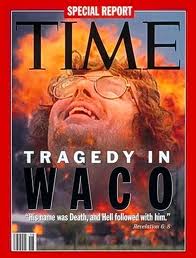
Tragedy at Waco 1993

     David Koresh, leader of the Branch Davidians in Waco, TX, was an expert at making conventional Christian doctrine and ideology support himself as the second Christ.  Using the Bible, particularly the Books of Daniel, Psalms, Isaiah and Revelation, he preached to his followers about the impending apocalypse and his own involvement in causing its start.

     Koresh’s Biblical apocalypticism was based on sacred text, (The Bible) an inspired interpreter, (Koresh) and the fluid context which an interpreter finds himself in.  (The government controlled the context ie: hostage rescue)  Koresh and his followers were deeply devoted to studying Biblical text.  Drawing from the Book of Revelation Koresh’s message was “highly systematic, rigidly consistent, and internally logical.”  According to his interpretation, Babylon, found in the Book of Revelation was the “evil government” and the federal agents sent on the purposed rescue mission were representing the 5th Seal.  To Koresh and his followers, surrendering to anyone but God was out of the question unless Koresh received word from God to do so. 

     This delay caused by Koresh waiting to receive God’s instructions irked those in charge.  The FBI was frustrated at the stand-off and showed little interest in hearing what Koresh had to say.  To them his words were senseless and those of a man with psychological problems.  The letters Koresh had written to explain his ideologies were passed off as babble and very little attention was given to understanding Koresh’s true intentions. 

     Sadly, the FBI promoted the persecution of Koresh and charged that he was a cult leader, child abuser, and rapist.  During the stand-off no proof was ever found to back these vicious statements.  As with Early Christians, persecution of new ideas was common.  Koresh expected to be persecuted just as Jesus Christ himself had been.  The Early Christians were prisoners to Roman Authority and now in 1993, Koresh who declared himself the second Christ based on Psalms and Isaiah mentioning the second Christ by the name Koresh, was under the same threat.   He believed and convinced his followers that they were being taken prisoners under governmental authority. 

      The whole scenario of this hostage rescue situation has an apocalyptic theme.  Preaching of the immanent return of Christ has taken place ever since his death.  It is a violent, fiery prediction based on the Book of Revelations.  In Koresh’s eyes, the attack of his fortress could only be viewed as the start of apocalyptic times.  There was no other way for this group of devoted Christians to view it as anything but the end.  The only statement Koresh gave to the FBI was they would leave the compound when God told him it was time.

     During the stand-off Koresh spent the majority of his time reading The Bible and trying to understand for himself what was taking place.  The letters he wrote and gave to his lawyer were passed on for examination to a college professor with no religious background,.  His determination that a peaceful end to the stand-off was not possible led to the FBI’s use of a gas attack on the compound.  The attack was tragic as the compound caught fire, trapping the innocent people inside and taking their lives. 

     There are many ways this stand-off could have gone differently.  Had the FBI made sincere attempts and sent agents with religious backgrounds to handle the negotiations or even brought in an outsider with knowledge of The Bible, perhaps this could have ended peacefully.  I don’t believe Koresh was purposely trying to cause the 5th Seal to be broken thus leading the government to attack.  Based on the reading, Koresh appeared to be forth-coming with his beliefs and reasoning for the accumulation of weapons.  The FBI was angered by Koresh’s absolute refusal to surrender to them and chose to take matters into their own hands.

     The entire rescue mission, based on false information of abuse ended the lives of 130 men, women and children.  Clearly these were unnecessary deaths at the hands of government intent on forcing a man to follow their commands.  Had someone in charge had the sense to send in people open to understanding a new religious ideology, this tragedy could have been avoided.  This incident left a black mark on our government’s historical record of backing religious freedom and ended the careers of many high level figures of the U.S. government.

~P.