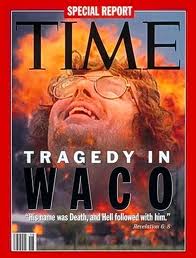
Tragedy at Waco 1993

     David Koresh, leader of the Branch Davidians in Waco, TX, was an expert at making conventional Christian doctrine and ideology support himself as the second Christ.  Using the Bible, particularly the Books of Daniel, Psalms, Isaiah and Revelation, he preached to his followers about the impending apocalypse and his own involvement in causing its start.

     Koresh’s Biblical apocalypticism was based on sacred text, (The Bible) an inspired interpreter, (Koresh) and the fluid context which an interpreter finds himself in.  (The government controlled the context ie: hostage rescue)  Koresh and his followers were deeply devoted to studying Biblical text.  Drawing from the Book of Revelation Koresh’s message was “highly systematic, rigidly consistent, and internally logical.”  According to his interpretation, Babylon, found in the Book of Revelation was the “evil government” and the federal agents sent on the purposed rescue mission were representing the 5th Seal.  To Koresh and his followers, surrendering to anyone but God was out of the question unless Koresh received word from God to do so. 

     This delay caused by Koresh waiting to receive God’s instructions irked those in charge.  The FBI was frustrated at the stand-off and showed little interest in hearing what Koresh had to say.  To them his words were senseless and those of a man with psychological problems.  The letters Koresh had written to explain his ideologies were passed off as babble and very little attention was given to understanding Koresh’s true intentions. 

     Sadly, the FBI promoted the persecution of Koresh and charged that he was a cult leader, child abuser, and rapist.  During the stand-off no proof was ever found to back these vicious statements.  As with Early Christians, persecution of new ideas was common.  Koresh expected to be persecuted just as Jesus Christ himself had been.  The Early Christians were prisoners to Roman Authority and now in 1993, Koresh who declared himself the second Christ based on Psalms and Isaiah mentioning the second Christ by the name Koresh, was under the same threat.   He believed and convinced his followers that they were being taken prisoners under governmental authority. 

      The whole scenario of this hostage rescue situation has an apocalyptic theme.  Preaching of the immanent return of Christ has taken place ever since his death.  It is a violent, fiery prediction based on the Book of Revelations.  In Koresh’s eyes, the attack of his fortress could only be viewed as the start of apocalyptic times.  There was no other way for this group of devoted Christians to view it as anything but the end.  The only statement Koresh gave to the FBI was they would leave the compound when God told him it was time.

     During the stand-off Koresh spent the majority of his time reading The Bible and trying to understand for himself what was taking place.  The letters he wrote and gave to his lawyer were passed on for examination to a college professor with no religious background,.  His determination that a peaceful end to the stand-off was not possible led to the FBI’s use of a gas attack on the compound.  The attack was tragic as the compound caught fire, trapping the innocent people inside and taking their lives. 

     There are many ways this stand-off could have gone differently.  Had the FBI made sincere attempts and sent agents with religious backgrounds to handle the negotiations or even brought in an outsider with knowledge of The Bible, perhaps this could have ended peacefully.  I don’t believe Koresh was purposely trying to cause the 5th Seal to be broken thus leading the government to attack.  Based on the reading, Koresh appeared to be forth-coming with his beliefs and reasoning for the accumulation of weapons.  The FBI was angered by Koresh’s absolute refusal to surrender to them and chose to take matters into their own hands.

     The entire rescue mission, based on false information of abuse ended the lives of 130 men, women and children.  Clearly these were unnecessary deaths at the hands of government intent on forcing a man to follow their commands.  Had someone in charge had the sense to send in people open to understanding a new religious ideology, this tragedy could have been avoided.  This incident left a black mark on our government’s historical record of backing religious freedom and ended the careers of many high level figures of the U.S. government.

~P.
Martyrdom and Memory Review

Pattie Crider

Professor Shusko

Christianity 275

Martyrdom and Memory Book Review

            Elizabeth A. Castelli, author of Martyrdom and Memory, clearly stated her thesis in the book’s introduction as, “a systematic means to understand the Early Christian collective memory of historical experiences of persecution and martyrdom as formed by culture.”  (Pg. 4)  Castelli believed it is the memory of Roman acts of persecution toward Christians that developed the legacy of martyrs.  Her novel, comprised of six chapters, began with the collective memories of early Christian martyrs and closed with the exploration of modern day martyrdom.

            Chapter one, titled “Collective Memory and the Meanings of the Past,” urges the reader to move past “what really happened” and focus on the memory of persecuted Christians.  French sociologist, Maurice Halbwach stated, “Memory is a socially constructed function that operates as an ideological ground for the present.” (Pg. 12)  The earliest written recollections were not recorded until long after the events had passed.  Due to this time lapse, scholars question the accuracy of martyr’s legends.  In accepting the documentation as a collection of memories, Castelli leads to the study, not analysis, of martyrdom. (Pg.24)  The question of truth and accuracy put aside, I was able to get a deeper understanding of the persecution of Christians and the development of martyrs.

            Chapter two, titled “Performing Persecution, Theorizing Martyrdom” gave historical accounts of “textual and artifactual traces of martyrdom’s ongoing cultural production.” (Pg. 33)  Roman historical records of law indicated the Christians were persecuted for many reasons.  They were charged with breaking civil laws for refusing to perform the required state sacrifices. (Pg.37)  The Romans also charged the Christians with outlandish crimes such as cannibalism, infanticide, incest, magic, and treason. (Pg. 42)  The false charges by the Romans are what made martyrdom possible because “Martyrdom is not just an action, it requires an audience.”   It also includes violence, suffering, and a meaningless death.  Jesus Christ’s sacrifice is the template for theorizing on Christian martyrdom. (Pgs. 34-35)  I understand this theory because Jesus was the only perfect human on earth, and he was persecuted and crucified despite his innocence.  This chapter also theorized why Christians refused to participate in the sacrificial rituals.  The obvious reason was it broke the commandment to only worship God, but it also removed Christians as the sacrificer to the position of sacrificial victim.  Essentially, the faithful followers of Christ were willing to sacrifice themselves to the one, true God. (Pgs. 51-52) 

            Three faithful followers are introduced in chapter three titled “The Martyr’s Memory.”  This chapter covered the self-writings of Ignatius, Perpetua, and Pionius.  All three of these martyrs practiced the ascetic act of renunciation.  I have learned about renunciation through-out two terms of religion and was able to fully grasp what these Christians gave up in their lives to live for Christ.  Ignatius basically wrote himself out of material existence in his Letters to the Romans. (Pg. 78)  He documented his sense of humiliation, submission, and lowliness but still felt he was unworthy of the torture and suffering which would ultimately lift him to the hands of God.  Ignatius persuaded others not to intervene on his behalf because through this self-sacrifice he was imitating Christ’s sacrifice for all mankind. (Pg. 84) 

            Perpetua’s diary is the earliest text by a woman.  The Diary of Perpetua shared her desire to be more than just called a Christian but to really be a Christian.  Perpetua was a well-born Roman wife, mother, and a Christian visionary.  Her renunciation of worldly roles enabled her to receive visions from God.  Her diary accounted a frightening experience in prison and also shared the emotional and physical pain of separation from her newborn.  God intervened on her behalf to wean the baby and dry up her milk supply so she could give full attention to her spiritual journey. (Pgs. 85-9)  I have no doubt that Perpetua was receiving visions from God, because I have suffered from separation of an infant.  The only thing that would have continued to keep me from my child would have had to be visions from God, because the bond between mother and infant is so incredibly tight. 

            Pionius’ texts are the most theatrical, and he portrayed himself as a master orator.  His commentary is witty and he purposely provoked a temple warden by “chaining” himself to other prisoners with woven cord.  This was done to show they were prepared to be sacrificed for refusing to participate in the Roman sacrificial rituals.  (Pg. 99) His words to the warden were “Light a fire and we will climb up to it ourselves.”  (Pg. 101)  The three Christians’ attempt to share their stories during their execution is written proof of their love and dedication to God. 

            Chapter four, titled “Martyrdom and The Spectacle of Suffering,” outlined the two vastly different views of Christian suffering.  The Romans were thrill-seekers and viewed executions as a functioning spectacle.  (Pg. 105)  They gathered in arenas to watch Christians be mauled by dogs, set on fire, or ripped piece by piece.  There were no limits to what the Romans could do, and these spectacles were promoted as religious, political, social, and civic functions in society.  (Pg. 107)  The Romans promoted the spectacles as special events that all citizens should attend.  Sharply contrasting this ideology was the Christian view.  I previously believed that Christians would view this as horrific acts of murder but learned in studying 1Corinthians 4:9 that Paul had proudly proclaimed, “We have become a spectacle to the world, to angels and to human beings.”  The Christians did not fear death at the hands of the Romans, but instead embraced it as their “completeness of faith” to God.  (Pg. 105)  Interestingly, the term martyr is derived from the courtroom meaning “witness.”  In this context, it is not what the “witness” has seen but the performance of the witness that transforms the seer into the seen, the testifier into the testimony. (Pg. 133)  I understand this as a martyr (witness of God) who willingly came forth and proclaimed their faith knowing they would die but hoped that those witnessing would see and understand their decision to accept death in the name of God.

            The fifth chapter, titled “Layers of Verbal and Visual Memory-Commemorating Thecla the Protomartyr” focused on the author of the Life and Miracles of Saint Thecla.  He claimed he did not write them out of concern that Thecla’s acts would become lost in oblivion or obscurity.  Instead, his goal was to assure that no one was ignorant of the words and acts of the Apostle Paul and the Saint Thecla.  This anonymous writer declared the acts of Thecla as “guarded by God in the service of his own perpetual fame.”  (Pgs. 134-5)  The story of Thecla is the earliest in literature concerning a Christian woman’s piety (Pg. 138) and Castelli found her to be the prototype for women martyrs.  Castelli noted in her book “The Acts of Paul and Thecla are well known and require only a brief, not detailed, exposition here.”  (Pg. 140)  Her focus is on the need for asceticism and described Thecla as “a Christian athlete and the virgin (who) is taken captive.”  Her renunciation of her wealth, family, lineage and all worldly goods to fully dedicate herself to God caused her family to declare her dead to them.  I found irony in this as I continued to read, because while her family considered her dead, her memory has lived on.  In fact, the earliest artistic artifact found was a fresco painting in a burial chamber dated in the mid-4th century depicting Daniel and Noah, Thecla and Jesus, Abraham and Isaac, Adam and Eve. (Pg. 157) Not bad for a woman whose family disowned her.

            The sixth and final chapter of Castelli’s book took me to the 21st century.  Titled “Religion as a Chain of Memory” she studied the story of Cassie Bernall of Columbine High School and compared it to the legacy of early Christian martyrdom. (Pg. 172)  The story of Cassie entering martyrdom was short and easy to understand.  She was asked if she believed in God, and when she replied “yes” she was executed.  When survivors shared what they had witnessed, Cassie was at first persecuted because of her reckless past.  As the media learned she had recently been saved during a youth ministry, Cassie was immediately presented as a martyr.  Initially her parents objected to her martyrdom (Pg. 182) but came to accept this title.  The memory of their daughter inspired cults, (as did Thecla) websites, CD’s, haunted house themes, plays, hats, key chains, t-shirts, necklaces and more. (Pg. 187)  Castelli found there was a negative view of this marketing and it had been labeled “the latest splash in American self-help.”  Her question to those with this view: “Were there critics in antiquity who called into question the tastefulness of pilgrim flasks bearing images of a half-naked Thecla…?” (Pg. 189)

I applaud Castelli for raising this point.

            In conclusion, Castelli’s book was a pleasure to read.  Her ability to write about the early Christian memories of martyrs and carry the understanding of their suffering from centuries ago to modern time was very effective.  I have a broader understanding of how martyrdom was developed by Roman authority.  Had the Romans not persecuted the Christians, martyrdom may never have come to exist.  It is collective memories of martyrs from the past that are now used to establish martyrdom in our modern times. 

Castelli, Elizabeth A.  Martyrdom and Memory.  New York. Columbia University Press.  2004. Print.

Indulgences For Sale

Yo Pope! We don't need no stinkin' indulgences!


Pattie Crider

Group 1 Response 4

Luther’s 95 Theses

 Indulgences for sale!  Get your Indulgences!

      The clearest concern found in Luther’s 95 Theses is the issuance of indulgences by the papacy.  At least 54 of the 95 clearly are directed at the receipt or issue of indulgences.  Luther believed the Catholic Church was greedy for taking money from even the poorest people.  In exchange the Pope forgave them of their sins in the name of God.  This is a clear problem in Luther’s opinion and his 95 Theses addressed this issue with bold words and new perspectives.

      Luther was thought of as a rogue priest in his actions of nailing 95 Theses to the Catholic Church door on the eve of All Saints Day.  This document was certain to raise a stir as Luther addressed his concerns.  These concerns would cause a serious financial issue for the Catholic Church.  Luther stated a true believer does not need to purchase his/her salvation.  Also, salvation cannot be bought for someone who is deceased.  The Church found this threatening because the sale of indulgences was a major source of its income.  The building projects in Rome during the early 16th Century were financed by the sale of indulgences.  To Luther, this was the church “selling grace” and from his perspective, unacceptable.  (Chidester pg 316)

      Luther’s 95 Theses was viciously biting toward the Pope.  He clearly had issues with the papacy and the payments they received for pardoning the transgressions of Christian sinners.  That is, the sinners who had enough money to buy an indulgence.  Luther raised this question to Christians: Does the Pope truly have the authority to grant forgiveness?  He also directly questioned the Pope on why his personal funds are not used in establishing new church construction. 

      Luther did not stop at just stating a believer didn’t need to purchase an indulgence.  He wrote that purchasing indulgences does nothing to save your soul and instead condemns it.  Further, he instructs Christians to provide for their families before paying the church for an indulgence letter and followed that with telling Christians the act of giving their money to help the poor is more pleasing to God than the purchase of indulgences.  He also explained that buying an indulgence letter is strictly voluntary.

     The perspective of all people having the ability to be saved by God without the means of purchasing a letter of indulgence seriously conflicted with what the Catholic Church was teaching.  Luther’s statements, especially his razor-edged cuts at the papacy certainly put their robes in a twist.  The Pope wanted people to believe their sins were forgiven through an indulgence letter because the Churches financial security depended on it.

      According to Luther, there were no guarantees in these indulgence letters.   Also, one should not take them so seriously that they lose their fear of God.  The fear was that humans would use the indulgences to assure themselves they are in good graces with God.  In doing this they would no longer fear the wrath of God and the possibility of eternal suffering in hell.  Luther believed it was in vain to think these papers would get you a golden ticket to Heaven. 

     To at least limit the churches influence on Christians concerning indulgences Luther wrote that preaching about indulgences for half or more of a sermon is injurious to God’s Word. He compares the receipt of indulgences to the nets of fisherman which now fishes for the wealth of men.  These are harsh words against the powerful papacy.  The controversial 95 Theses spread quickly by means of the printing press and the church had to respond.

     The Catholic Church found their priest to be a heretic and erroneous in his theses.  Luther was given the chance to take back all he had written but instead he showed he could be even more defiant.  His life was spared but he was excommunicated in January 1521.  (Chidester pg. 317)  Though he was kicked out of the Catholic Church, Luther’s perspectives carried on.  It was his Christian ideologies that led to the establishment of the Lutheran faith.

PS. I received an A on this paper.  🙂

THE GEORGIA GUIDESTONES

http://www.thegeorgiaguidestones.com/

This is scary stuff!!! Are these the ten commandments? What do you think??

I’d like to take a road trip and see them.